A Pig Story
By Hines Boyd, a 6th Generation Farmer
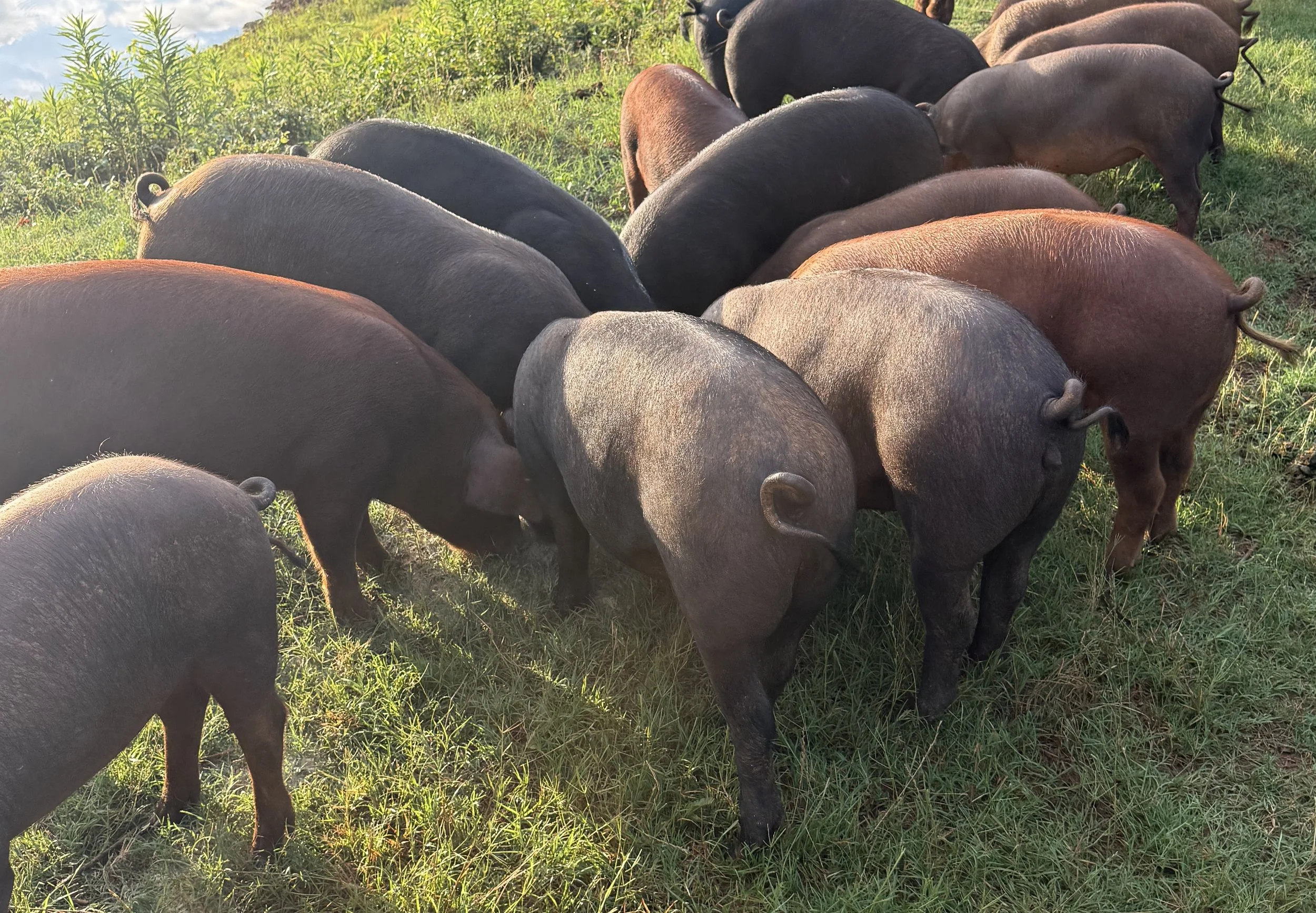
The Iberian Grazer is a hybrid heritage pig designed to efficiently produce flavorful, beefy-tasting, red, well-marbled pork in an outdoor, small farm, pasture setting. It is built on four heritage breeds. The base breed is the renowned Iberico. The Chinese Meishan contributes prolificacy and superb taste. The Red Wattle and Berkshire, also known for great taste, add faster and more efficient growth.
How it Started
Bringing Iberico to Texas
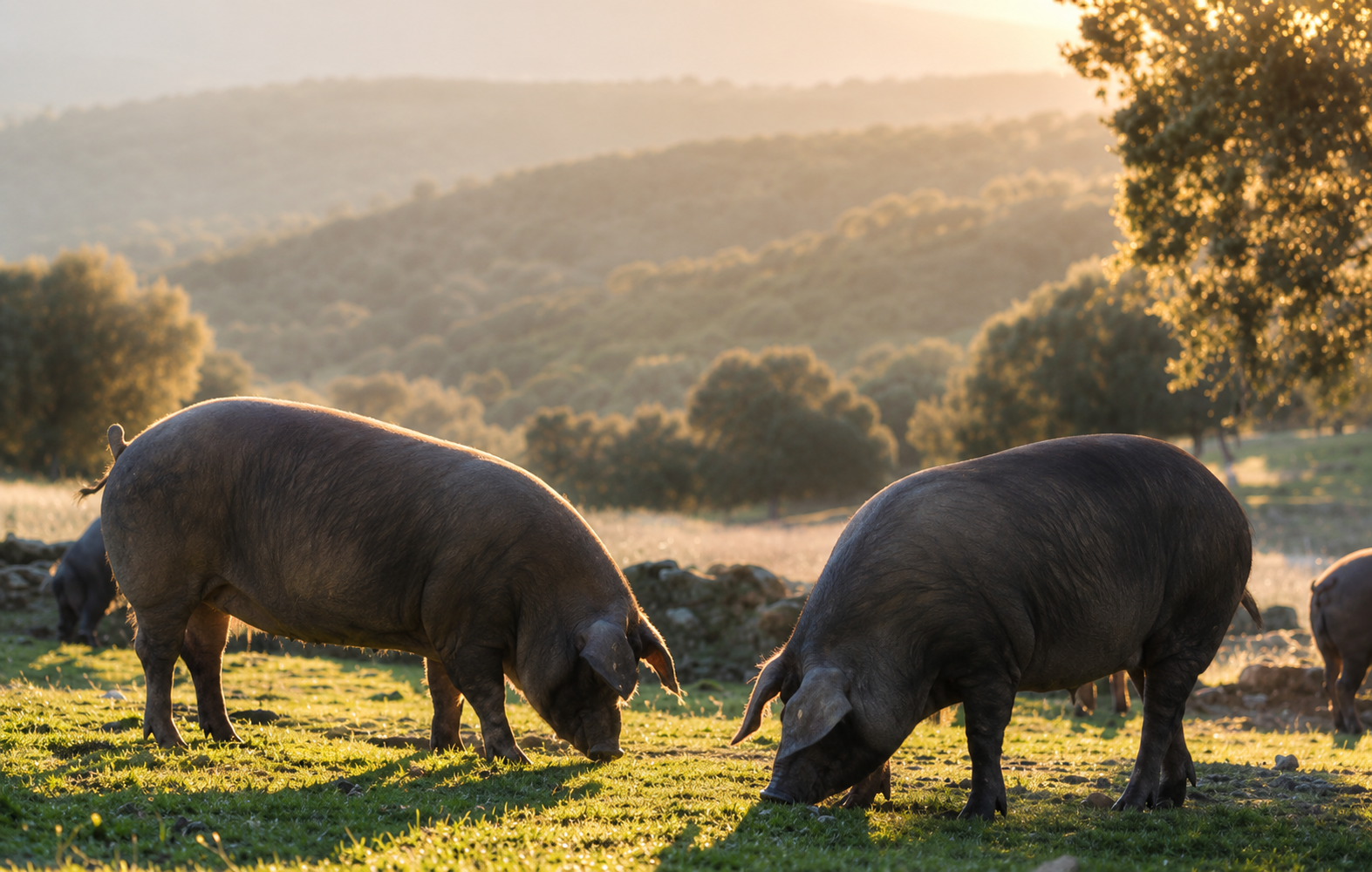
In 2014, Florida farmer and agriculturalist Hines Boyd, worked with two Spanish entrepreneurs to import 155 Iberico pigs from Spain to Texas. It is believed to be the first US importation of this iconic pig breed in nearly two centuries. Within about a year, two more importations had arrived on U.S soil. One from Spain went to a Georgia farm; another from Portugal went to Arizona. A fourth, smaller import from Portugal appears to have gone to a northeastern state.
Shortly after, officials in Spain and Portugal seem to have shut down the export of live Iberico pigs. But those 2014-2015 imports are a good genetic base for building a national herd of American Iberico.
Boyd & Glendower Farms
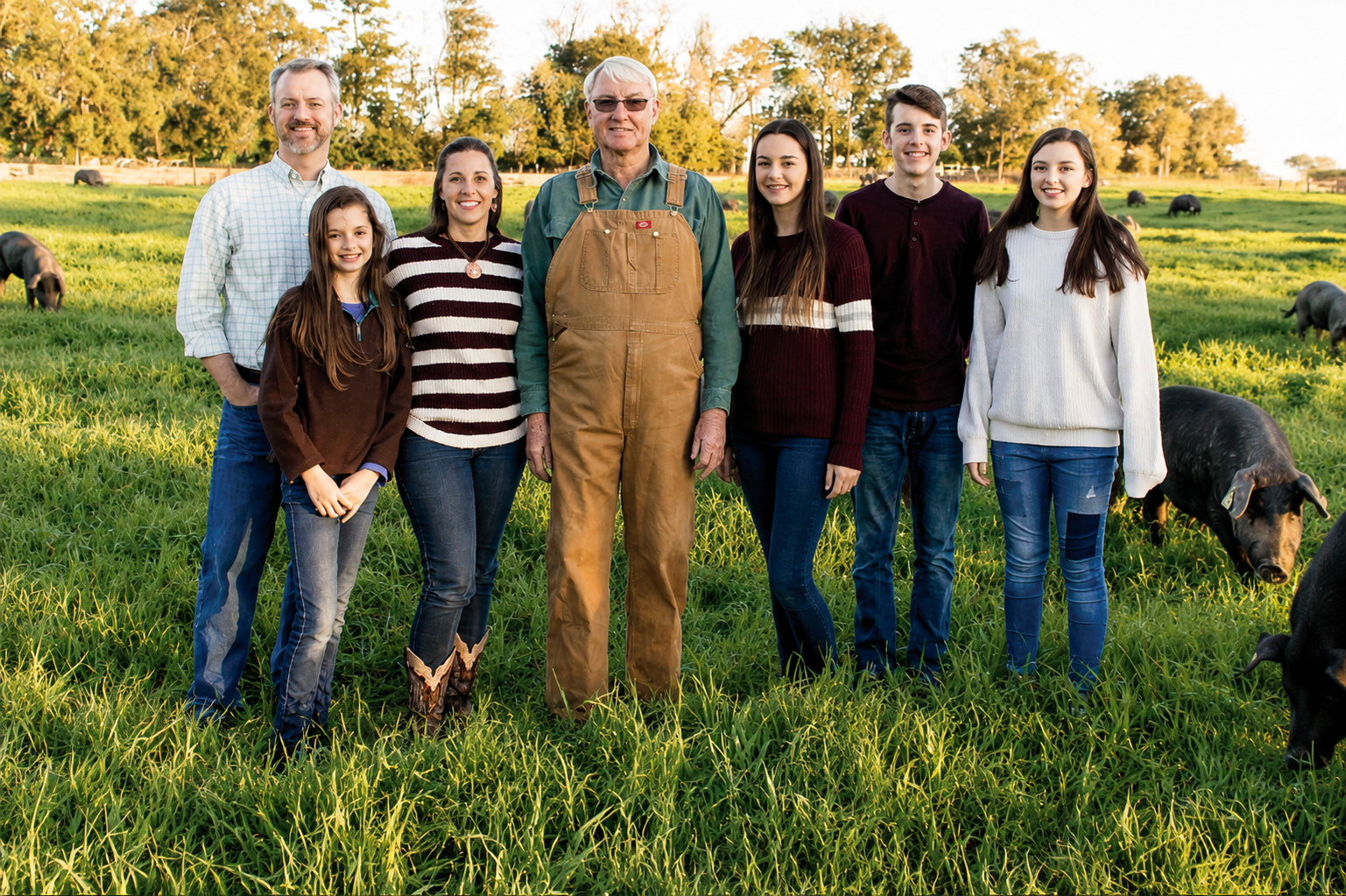
In 2015, Boyd brought 20 of the Texas pigs to his eight-generation family farm, Glendower, in North Florida. He began breeding and growing them on pasture there. (Hines Boyd holds a PhD in Agriculture from the University of Florida with a specialty in Animal Breeding.) The Spanish entrepreneurs in Texas were going to market the pigs for him.
The Glendower Farms herd grew quickly—much faster than the market. Hines soon learned two important things about those Iberico pigs: (1) the meat was FABULOUS, and (2) the pigs were very expensive to grow. They weaned small litters, grew slowly, and converted feed more inefficiently than desired. Getting a price point that made producing the purebred Iberico profitably in the US market was difficult.
The Challenge: How to profit from Iberico Genetics
Boyd turned to his animal breeding background. The first step is a sound and diverse reservoir of purebred Iberico genetics. And Boyd had that on his farm. The second step is to identify other breeds that can boost the production efficiency of the Iberico without diminishing the highly desirable characteristics of Iberico meat, and then crossing them with the Iberico.
Boyd believed that the most likely source of similar meat quality would be found in heritage breeds of pigs. So, he began researching and looking for heritage breeds that approached the Iberico in meat quality but could also add traits that would improve production efficiency.
Boyd identified four breeds that seemed to have promise for a crossbreeding trial. Because of his training in animal breeding, he knew that he could also count on heterosis—or hybrid vigor—to add a boost to production traits like litter size and growth rate.
In the summer of 2019, Hines brought in a Red Wattle boar and gilt and two Tamworth gilts. The next summer, he added a Berkshire boar, followed by a Meishan boar in 2021. About 15% of his herd was eventually crossbred, though he was careful to faithfully maintain his purebred Iberico genetics.
He studiously observed the crosses, looking for effects on growth, vigor, and meat quality. He observed the F1 cross females for effects on litter size, weaning rates, maternal instincts, and temperament. He noted significant heterosis (hybrid vigor) effects for growth in the Red Wattle crosses and especially in the Meishan cross.
In one group of pigs raised together until 4.5 months, the Meishan x Iberico crosses were 55% heavier than their Iberico same-age counterparts! He was able to grow a couple of Red Wattle x Iberico cross barrows to a 275-pound slaughter weight in less than 8 months—much faster than was possible with a purebred Iberico.
THE PUREBRED AND CROSSBREEDING TRIAL
The Berkshire x Iberico crosses showed added growth rate and muscling. The F1 (first generation) females from both Red Wattle and Meishan crosses with Iberico were able to farrow (birth) and wean litters that were at least 50% larger than their purebred Iberico counterparts.
The most important part of the crossbreeding trial was to observe meat quality in the crosses. Boyd cooked and ate a lot of the pork himself. He used his family and friends as taste panelists. He also found a small USDA processor who allowed him in the cutting room to observe carcass characteristics. Together, they experimented with different ways to process the pigs. They made many different sausages and lots of short-term charcuterie products like bacon, pastrami, and brined loin cuts. They made lard from the high-quality fat. In other words, the meat from the Iberico and its crosses was given a good “test drive.” Here are some results from that test drive.
The Iberico and the Meishan-Iberico crosses were practically indistinguishable—especially the chops. If anything, the Meishan crosses were less likely to have a thick cap of backfat. Their bellies had a higher lean-to-fat ratio than the purebred Ibericos, probably because those bellies needed more muscle in them to support and farrow larger litters.
The Red Wattle and Berkshire crosses were slightly less red with barely noticeable differences in meat texture. The Red Wattle cross, when grown fast, seemed to be a little more tender, possibly due to its younger age. The Berkshire crosses had larger loin muscles and hams, traits inherited from the large Berkshire sire. Overall, the taste, texture, chew, and juiciness (from intramuscular fat) were excellent in all four crosses. All had a robust, beefy taste.
The Tamworth crosses, while quite productive, did not have the deep red meat color and beefy taste Boyd was looking for. It was a more “porky” eat. So, this genetics was not used in the Iberian Grazer hybrid cross.
BUILDING AN IBERIAN GRAZER HYBRID BREEDING PROGRAM: WHAT’S NEXT?
After 5 years of research and observation, Boyd settled on 4 breeds to initiate the hybrid Iberian Grazer.The Iberico would become the primary breed, always accompanied by the Meishan because of its exceptional meat quality and its genetic ability for huge litters. Additionally, crosses would include the Red Wattle or the Berkshire, or both. These two breeds also bring high meat quality. The Red Wattle is lean, fast growing, and capable of larger litters than most heritage breeds. The Berkshire adds muscling and good growth rate. All four breeds excel in pasture settings. They are all good grazers and active on pasture, a trait that enhances red meat color.
Boyd developed a protocol for crossing these four breeds. It allows the ratio of Iberico to vary from 25% to 75% to provide flexibility to introduce the three other breeds into the crossing mix. It requires that the Meishan always represents at least 1/8 of the genetic contribution and that either the Berkshire or Red Wattle have at least a 1/8 contribution. So at least three of the four breeds must always be present in the crossing mix. No breed, other than Iberico, could ever represent more than 5/8 of the mix.
Thus, an Iberian Grazer breeder would always be working toward a mix that would have 3/8 to 5/8 Iberico, 1/8 to 1/4 Meishan, with the balance being Berkshire and/or Red Wattle. For example, a breeder might start by creating a Meishan x Berkshire sow and a Meishan x Red Wattle sow. The litters will not be Iberian Grazers, but they provide the needed base litters. Then breed the offspring from those two litters to purebred Iberico boars to create the Iberian Grazer hybrid. The resulting crosses would be a ½ Iberico ¼ Meishan ¼ Berkshire litter and a ½ Iberico ¼ Meishan ¼ Red Wattle litter. If the breeder then mated a boar and a sow from these two different litters, the offspring would be ½ Iberico, ¼ Meishan ⅛ Berkshire, and ⅛ Red Wattle.
If a breeder preferred, for example, to have a larger Berkshire presence in the herd, he/she could begin with an Iberico x Meishan cross. We know this cross has a lot of heterosis for growth and litter size. So, when bred to a Berkshire boar, one would expect this crossbred base sow to produce large litters with growthy piglets. They would be ½ Berkshire, ¼ Iberico, ¼ Meishan and qualify for Iberian Grazer designation. But in the next mating, the breeder would need to begin to look for ways to increase the Iberico genetics to maintain an Iberian Grazer designation.
WHERE WE INTEND TO END UP: A COMPOSITE BREED?
Obviously, there are lots of mating options that require careful planning and good records. But, because the breed is still considered a hybrid, the options allow the Iberian Grazer breeder to build a pig that suits their production system and market. Eventually, when numbers grow, the breed ratios in the broad population of Iberian Grazers may stabilize as breeders reach a consensus about which ratio is “best.” At that point, sometime in the future, the herd book might be closed and the Iberian Grazer could become a composite breed—like the Beefmaster or Santa Gertrudis or Brangus.